

















Des Collins is best known for leading the Corby toxic waste case, a legal battle in which atmospheric pollution was linked to birth defects for the first time.
In 2009, after 10 years, Corby Borough Council were found to be negligent in transporting toxic waste through the town in open lorries, a story that was brought back into the public consciousness through last years’ Netflix drama Toxic Town.
LGLegal’s Features Editor, Emily Whitehouse spoke to Des about his involvement.
 What was your first point of contact with the mothers involved in the case?
It was as a result of my reading The Sunday Times. One of the investigative teams was up in Corby. I think they were actually looking at corruption with regard to the steelworks reclamation, which was rife at the time.
They became aware of a number of mothers who had given birth to children with limb defects and ran an article about it. I found the story interesting because I went to school in Corby and had worked at the Steelworks as a student for a short time.
I knew one of the journalists who had been involved in writing the article, so I phoned him up and said, “what do you know about this?” So he told me about it, and as a result, I was introduced to the mothers. It was really about being in the right place at the right time and knowing the right people.
Was there any hesitation in taking the case, given it was unprecedented territory linking atmospheric toxic waste to birth defects?
I did have a lot of hesitation accepting the instructions, but I found it interesting. A lot of people said to me, “you are absolutely crazy to embark on this, because it won’t go well.”
But I became involved in the issues regardless and it became something I had to succeed at. I remember saying to myself, “I won’t let this beat me.”
This case has been compared to a ‘British Erin Brockovich’, and the two of you featured in an interview last year, how does that comparison make you feel?
Embarrassed. Don’t forget, I was doing that case as a job – I’m a professional – but she was doing it as a campaigner. So yes, I’m embarrassed to be compared to her because she was doing it for possibly ‘better’ reasons, but the job had to be done.
Going back to the case, at what point did you feel confident enough that you could prove the link between the toxic waste and the birth defects?
If you want the facetious answer, it was about five seconds after the judgement came out.
We were never entirely confident. I sat down with all the mothers and say “this is difficult, the chances are – as everyone predicts – we’re going to lose, so make sure you bear that in mind as we move forward to the trial process.”
So, shortly before the trial, we put proposals to the defendants which would have resulted in a settlement – and not a particularly advantageous settlement, as far as the mothers were concerned – but it was a proposal put forward on the basis we thought our chances of winning were not as great as they might be. However, around four months before the trial started, the council rejected it , so we had no alternative but to go to court.
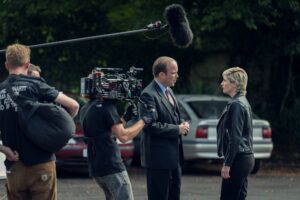
Rory Kinnear, playing the role of Des Collins, with Jodie Whittaker, playing one of the mothers
Can you describe the atmosphere in the courtroom when the judge announced your victory?
Electric. But judgements like that are delivered to lawyers in paper, about three days before, so we can correct typos and things, so we knew. So we were in the difficult position of being in court with all the mothers, and we knew what the outcome was for two days beforehand, but they didn’t. So that was slightly difficult, but it was electric, yes.
At what point were you made aware that a TV series was being considered?
I was told about it fairly early on. The Horizon documentary was broadcast in 2020 and about two months after that, I got a call from one of the eventual producers of the TV series. She’d watched the BBC documentary and thought it would make wonderful material for Netflix and asked if I wanted to be involved.
Of course, I agreed. I was involved but not on a day-to-day basis, I had four or five meetings over a six-month period, just chatting about the case rather than the production.
You have recently called for a public apology. What do you think such an apology would mean to the families today, after all these years?
The apology would mean a huge amount to them, especially considering the reaction following the trial, where the council blamed the families for embarrassing them and making them run out of money – although it was open to the council to insure against this, in the same way I made sure the mothers were insured against losing.
Unfortunately, I think it’s even less likely now that the council will provide an apology. Even though there is a new local authority in place, they’re still taking the same approach they’ve taken for 20 years.
And now we’re looking at an allegation by some of the residents that there’s an excess cluster of cancer cases in Corby as a result of where the reclamation was carried out. Of course, the council are being as obdurate as they always were, they just won’t respond fully or properly to the concerns of residents.
Can you tell us more about these new cases?
They’ve been floating around for several months and have been brought forward by mothers whose children have been born with cancer. We don’t know exactly what has caused this, but the concern is that it is related to toxic waste.
Most of the waste was supposed to end up in a place called Dean Quarry, but not all of it did because it wasn’t big enough. The concern now is, where did the rest of it go and is that now causing problems? We’ve tried asking the council, “you dug the waste up – you don’t deny that because there’s a court judgement saying you moved it. Can you please now tell us where you put the excess?”
As we speak, the council is refusing to say where the excess is buried. In fact, the latest communication we’ve had with the local authority is that it’s not a matter of public interest, so they won’t tell anyone. If that’s not a matter of public interest, then I’m not sure what is.

Lauren Lyle played the role of Des’ colleague Dani Holliday
The Corby Case became a landmark in environmental justice. Do you think the law has evolved enough since then to stop another community from suffering in the same way?
In all probability, no. The Environmental Protection Act doesn’t provide the protection which people thought it would. Litigation is hugely expensive and legal aid has effectively, for all practical purposes, gone. So the only funding for what we call group actions or class actions, is funding which is provided by investors.
Investors will provide funding in some circumstances. For example, if 50,000 people wanted to sue because their car exhausts are not up to scratch despite being told they were, and each of those people will receive a compensation payment of £3,000, you can get investors interested, because it’s low-hanging fruit, it’s easy money.
However, if you said that you wanted to sue a local authority for a decontamination project that went wrong 20 or 15 years ago, no-one’s going to touch it.
Are there any lessons other UK councils should take from what happened in Corby?
Yes, I think some lessons have been learned, and I think Corby was the worst or best example of amateurs trying to deal with a situation which should be left entirely to the professionals.
I think people have now realised that it is far more technical and far more potentially damaging to the public than was otherwise thought, so I think that’s good.
The result of that is, however, that very often the land is simply left there with nothing happening to it, apart from the fact that it starts leeching out problems in one form or another, which is not achieving the result we would all want. But I think if one thing was learned, it is that you can’t get a bunch of amateurs to do this work, it is entirely for professionals. The fact that the council don’t have the money available to them is just political.
This is an abridged version of an article that first appeared in Air Quality News. The full interview can be read here.
Leave a Reply