














As North Northamptonshire councillors consider backing Zane’s Law, we examine how the campaign has progressed since its launch and speak to Zane’s father about the fight for change.
Zane was just seven years old when his home was flooded. The waters had passed through a toxic landfill site and delivered Hydrogen Cyanide into the house. The entire family was hospitalised. Zane died and his father, Kye Gbangbola, was paralysed from the waist down.
If you are involved in the environmental sphere you might well have heard of Kye Gbangbola and Nicole Lawler, the people advocating for Zane’s Law – legislation that they hope will become the first to protect communities against toxic landfill.
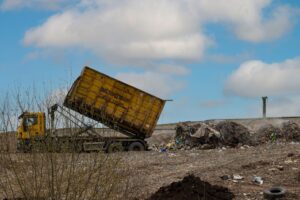
The Environment Agency were accused of being a ‘reluctant regulator’ in a row over the air pollution caused by Walleys Quarry in Newcastle-under-Lyme.
Zane’s Law was first proposed by his parents at COP26 in 2021. It calls for councils and the Environment Agency to keep a regularly updated register of potentially contaminated land, inspect identified sites and criminalise the withholding of information about risks to public safety.
The campaign has gradually built political and institutional support. In late 2024, the London Assembly unanimously backed a motion calling for stronger national action on contaminated land, including a comprehensive public register of toxic sites and tougher duties on authorities to investigate and remediate them.
In 2025, the Trades Union Congress endorsed the proposal and backed campaigning by the Fire Brigades Union for tighter regulation of historic landfill sites, while the mayors of London, Greater Manchester and Liverpool also threw their support behind the campaign.
Although legislation has yet to be introduced, the campaign continues to push for national legislation on contaminated land safety.
 Kye Gbangbola, Zane’s father, explains: ‘Zane’s Law is about protecting people, very much like the Clean Air Act. We felt the need to create it as we never want anybody to go through what we did. People should be able to access information about the land they live on. Just because some toxins are invisible, it doesn’t mean people can’t seriously be affected by them.’
Zane (pictured) died in 2014 but, as Kye explains, the story begins in four years earlier. ‘In 2010 The Environment Agency were involved in the construction of a new property, no more than 10 yards from our home,’ he says. ‘A geotechnical report said there was an unacceptable risk of injury or even death coming from migrating landfill gasses, so they put a gas proof membrane in the property.
‘However, none of the other properties in the area had any protective measures, so they were left exposed to the harmful gasses. We didn’t even have any idea they existed as public information stated the land was clean.’
In 2014 major flooding hit the South of England, and the basement of Kye’s home was filled with water. Water that had passed through a toxic landfill site situated behind the house.
‘It was terrifying,’ Kye says. ‘We lived in a Victorian property that was prone to flooding, but it was only ever the basement that was affected and you could just use pumps to clear out the water. However, in the early hours of 8th February, me and my family were removed from our house unconscious. I don’t recall experiencing any symptoms, whatever happened to me was pretty instant. The last thing I do remember is my wife and my son watching the opening ceremony of the Winter Olympics, and I was working on a book I was writing in the next room. The last thing I heard before falling unconscious, was my wife screaming for help for our little boy.
‘When the fire brigade turned up on the scene, they forced everybody to evacuate their homes, people were taken to hospital and our entire area was cornered off. When I woke up in the hospital, I was in a very sorry condition, completely confused and dazed, but this is where my wife told me that our beautiful son, Zane had died.’
While Kye was in the hospital he was suffering an extreme skin reaction and about 12 hours after the incident, he began to slowly loose sensation in his legs. After 24 hours he had lost all feeling in them. However, it wasn’t until months later that one doctor diagnosed rhabdomyolsis caused by hydrogen cyanide poisoning.
‘After the accident an inquiry was launched where some of my neighbours said the fire brigade woke them up and told them they had detected traces of hydrogen cyanide,’ Kye says. ‘However, on the night of the incident an emergency COBRA meeting was called, where the government issued a statement claiming Zane died from carbon monoxide poisoning from an old petrol pump that was used to clear some of the water that had flooded our basement.’
After the statement was made, Zane’s parents accessed public health documents which confirmed firefighters found hydrogen cyanide traces their home. Since then, the couple have campaigned relentlessly for the implementation of Zane’s Law and an Independent Public Inquiry to be held to look into the death of their son.
‘The purpose of the inquiry is to identify what should go on his death certificate,’ Kye says. ‘At the moment, not only does it say he died from carbon monoxide poisoning, but the coroner also claimed Zane died a day earlier than he did.’
Kye continues: ‘The support we’ve received from the public, various organisations and authorities regarding Zane’s Law and the Independent Inquiry has been really overwhelming. The Fire Brigades Union and Unison have pledged their support for the inquiry and now that Labour are in power, we feel more hopeful than ever that it will go ahead. In 2019 Zane was included in the party’s manifesto, which called his death a “huge injustice” and since Labour have been elected, Keir Starmer has spoken out for Zane on numerous occasions.
‘A child’s death should never be a political matter, but when it comes to Zane, I’m pleased to see discussions are happening. Currently, we don’t have a timeframe for when the inquiry will happen, but we are doing everything we can to push for it.’
Alongside these efforts, Kye points out that five councils across England and, as of 9th September, the Green Party, have accepted Zane’s Law as one of their policies. He says: ‘Lewes were the first council to accept the law in February and I’ll never forget that day. The local authority accepted the law unanimously to a standing ovation. Brighton and Hove City Council were the second to accept the law in March and Adur District Council followed on the same evening. Lately, Stroud and Worthing have become the latest councils to accept the law with open arms.’
It all seems positive that more and more councils are climbing onboard with the idea of Zane’s Law, but Kye remarks he won’t rest until it has received Royal assent.
‘Among all the pain me and my wife have experienced over the last ten years, something that has brought me a little bit of joy is when councillors come together, despite what colour they’re supporting, and agree that more needs to be done to prevent people from living on or near contaminated sites.
‘Statistics show 80% of people in the UK live within two kilometres of landfill and yet I bet the majority don’t even know it. If we can get Zane’s Law passed it would really help present and future generations. I know it would also make Zane happy. Me and my wife have been environmental campaigners for quite some time and when we used to go and speak to schools and if Zane was on holiday, he would begin our presentations. I miss him every day, but I hope I’m doing him proud by campaigning for justice.’
Follow the campaign at: https://www.truthaboutzane.com
Leave a Reply