














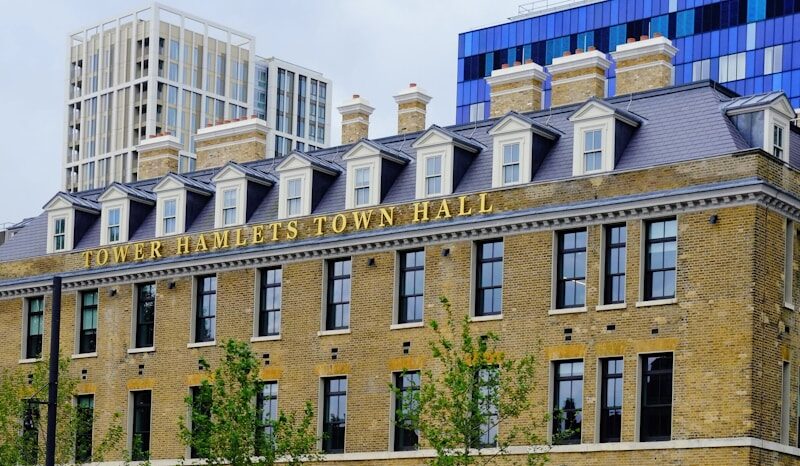
The High Court has overturned Tower Hamlets council’s decision to approve an 18-storey office tower on Whitechapel High Street, following a legal challenge by heritage campaign group SAVE Britain’s Heritage.
The proposed development by Lipton Rogers, designed by Foster + Partners, would have retained only the facades of several historic buildings within the Whitechapel High Street Conservation Area. The scheme was approved by councillors in March last year despite a recommendation for refusal from planning officers and nearly 300 public objections.
Justice Mould ruled that the decision to grant planning permission was unlawful, finding that councillors failed to provide adequate or intelligible reasons for their approval.
Matthew Fraser of Landmark Chambers, representing SAVE, argued that the approval was ‘irrational’, based on reasons that were ‘unsubstantiated by any evidence’ and ‘so generic as to be meaningless’. He said the decision failed to engage with officers’ recommendation for refusal.
Planning officers had warned that the 41,000 sq m tower would be “at odds” with the surrounding townscape. They also noted that approving the scheme could require the site to be removed from the conservation area in a future review if the tower is built.
Henrietta Billings, director of SAVE Britain’s Heritage, said the councillors’ reasons were “clearly faulty and unjustified”. “With the support of local residents and Whitechapel community organisations, we are pleased to have been able to successfully challenge them,” she added.
The campaign was backed by neighbouring institutions Whitechapel Gallery and Toynbee Hall. Whitechapel Gallery director Gilane Tawadros welcomed the ruling, describing the area as ‘uniquely special’ with “global relevance as a beacon of cultural and creative innovation”.
The High Court’s decision means the planning application will now return to the council for a second vote. The scheme has been on Lipton Rogers’ books for more than nine years, with previous iterations withdrawn or rejected following public opposition.
Councillors have previously argued that the development would make effective use of a site currently used as a car park and could reduce anti-social behaviour in the area, including alleged drug dealing.
Leave a Reply